Choose one that is recent, peer-reviewed in an indexed venue, reproducible with a public dataset (ideally with public code), and has a limitation you can fix in your time frame. Search IEEE Xplore, SpringerLink, ScienceDirect, arXiv and Google Scholar, then run each candidate through the checks below before you commit.
What is a base paper for a project?
A base paper is the one published paper your project is built on. You reproduce its method on its dataset, check that you get close to its reported numbers, then change one thing and measure the difference. The reproduced numbers become your baseline, the paper’s limitations become your problem statement, and the paper is cited throughout your report.
How far you go depends on your level. A B.Tech project may stop at a clean reproduction with a working demo; if you have no topic yet, start from these final year project ideas for CSE and look for a base paper on the one you pick. An M.Tech project is expected to add an improvement you can measure; see how M.Tech projects are scoped. A PhD rests on a full literature review rather than one paper, which the PhD synopsis guide covers.
If your college asks you to prepare or present the base paper at your first review, a one-page summary is enough: the problem, the dataset, the method, the reported results, the limitations the authors admit, and the one change you plan to make.
How do you find a base paper for project work?
Start with the databases where peer-reviewed engineering papers are published, and use the free search engines to cover them together. Most students looking for IEEE papers for projects start at IEEE Xplore, then widen the search on Google Scholar.
| Source | What it holds | Full-text access |
|---|---|---|
| IEEE Xplore | IEEE journals, magazines and conference proceedings; IEEE reported passing seven million documents in November 2025 | Abstracts free; full text through your library, open access or ONOS |
| SpringerLink | Springer journals, books and conference series such as LNCS | Abstracts free; full text through your library or open access |
| ScienceDirect | Elsevier journals | Abstracts free; full text through your library or open access |
| ACM Digital Library | ACM journals, conference proceedings and magazines | Free: ACM’s publications have been open access since 1 January 2026 |
| arXiv | Preprints in computer science, maths, physics and more | Free; moderated, but not peer reviewed |
| Google Scholar | One search across publishers, with “Cited by” and year filters | Free search; “All versions” can lead to an author’s own copy |
| Hugging Face Papers | Recent machine learning papers with linked code and models | Free; the old Papers with Code site now redirects here |
Access rules change. Check with your college library what it subscribes to.
If you study at a government-run college or university, ask your library about One Nation One Subscription (ONOS). It started on 1 January 2025 and gives students and staff at participating central and state government institutions access to journals from 30 publishers, including IEEE, Elsevier and Springer Nature, through INFLIBNET.
How do you search so you find a usable paper?
- Search task, dataset and method together, for example “skin lesion classification HAM10000 vision transformer”. Naming a public dataset brings up papers you can actually reproduce.
- Limit the years to the last two or three in IEEE Xplore or Google Scholar.
- Open “Cited by” on a promising paper. Newer papers that improved on it show what is already done and give you extra baselines.
- Read the abstract, the results table and the limitations first. Most candidates can be ruled out before you read the full paper.
How do you choose a good base paper?
Check every candidate against the same criteria. A paper that fails on data or reproducibility is a no, however good its results look.
| Criterion | What to check | Good sign | Warning sign |
|---|---|---|---|
| Recency | Year of publication | Last two or three years | Over five years old, unless you only need it as an extra baseline |
| Venue quality | Where it was published, and whether that venue is indexed | Indexed venue A journal found in Scopus Sources or the Web of Science Master Journal List, or a CS conference ranked in ICORE | A journal that only calls itself “IEEE-format”, or one you cannot find in any index |
| Reproducibility | Preprocessing, architecture, hyperparameters, data split and metrics | All stated, with an architecture figure | “Parameters were tuned” with no values |
| Dataset | Whether you can download the exact data | Public dataset with a clear licence | “Available on request”, or a private hospital or company dataset |
| Code | Whether an official or trusted implementation exists | Code available An official repository, or code linked from the IEEE Xplore page through Code Ocean | No code and results far above other papers on the same data |
| Scope for improvement | The limitations and future-work sections, and your own error analysis | A named weakness you can test, such as class imbalance, explainability or speed | Nothing left that fits your time frame |
| Compute | Model size and training time | Trains in hours on a free cloud GPU or your laptop | Needs a GPU cluster or weeks of training |
| Integrity | Retractions and corrections | No notices on the publisher page or in the openly available Retraction Watch data | Retracted, or carries an expression of concern |
Your guide may set stricter rules on recency or venue. The UGC-CARE journal list was discontinued by a UGC public notice in February 2025, so check indexing directly: see how to check if a journal is Scopus indexed and what replaced the UGC CARE list.
What are the red flags in a base paper?
- Near-perfect accuracy on a small or imbalanced dataset, with no code and no confusion matrix.
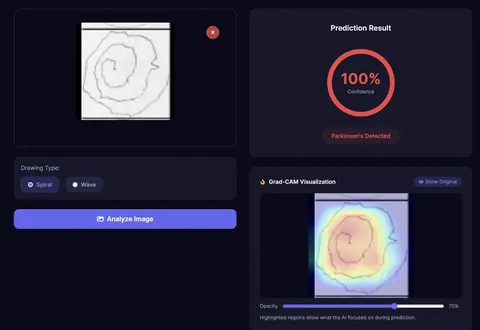
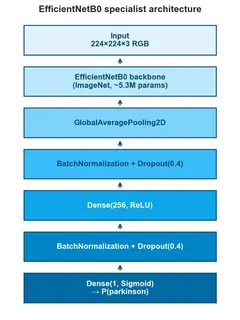
- Signs of data leakage: images of the same patient in both training and test sets, augmented copies made before the split, or a random split on time-series data. Our Parkinson’s detection from spiral drawings case study shows how augmenting before the split inflated validation accuracy, and why the unseen test set gave the realistic numbers.
- No baseline table, or baselines copied from papers that used a different split.
- A “novel” model that is a known one renamed, never compared with standard alternatives.
- A doubtful venue: publication promised in days, fees before review, or metrics you cannot verify. See how to identify predatory journals.
- A survey or review article. Reviews are good for your literature survey, but there is no single method to reproduce.
- An arXiv preprint with no published version, if your guide wants a peer-reviewed base paper.
How do you check a base paper can be reproduced before you commit?
Give your top candidate one focused week before you tell your guide it is final.
Get the exact data
Download the dataset, read its licence and confirm the class counts match the paper.
Rebuild the split
Recreate the training, validation and test split the paper used. If the paper does not describe it, note that as a risk.
Run the code
Run the official code if it exists; if not, start from a well-known library implementation of the same model.
Match one headline number
Reproduce one main result, such as test accuracy or F1, within a few points of the paper, and record the gap either way.
Time it and decide
Note the training time and hardware, multiply by the runs you will need, then commit or move to the next paper on your shortlist.
How do you turn a base paper into your own M.Tech contribution?
Your contribution is the measured difference between the base method and yours. Keep it to one clear change, tested fairly.
- Reproduce the base method on the same data and report your own numbers for it, not only the paper’s.
- Pick one limitation, from the paper’s own discussion or from your error analysis.
- Make one change aimed at it: a stronger pretrained backbone, class-imbalance handling, explainability, cross-dataset testing or a lighter model for deployment.
- Compare on the same split and metrics, and add an ablation study that shows what each part of your change adds.
- Report honestly, including where the change does not help, and state which parts come from the base paper.
Reusing public code is normal when its licence allows it. Cite the base paper, say exactly what you reused and what you built, and follow your university’s academic rules.
What does a sample base paper plan look like?
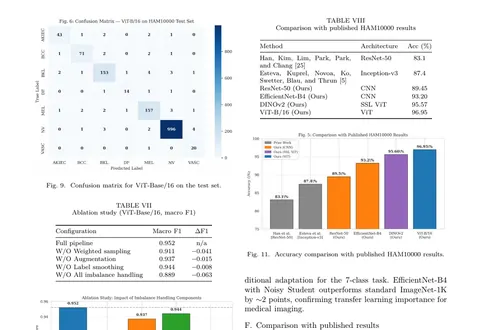
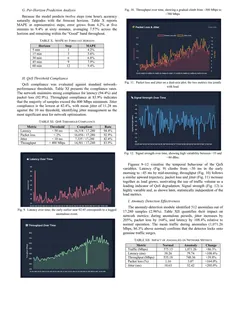
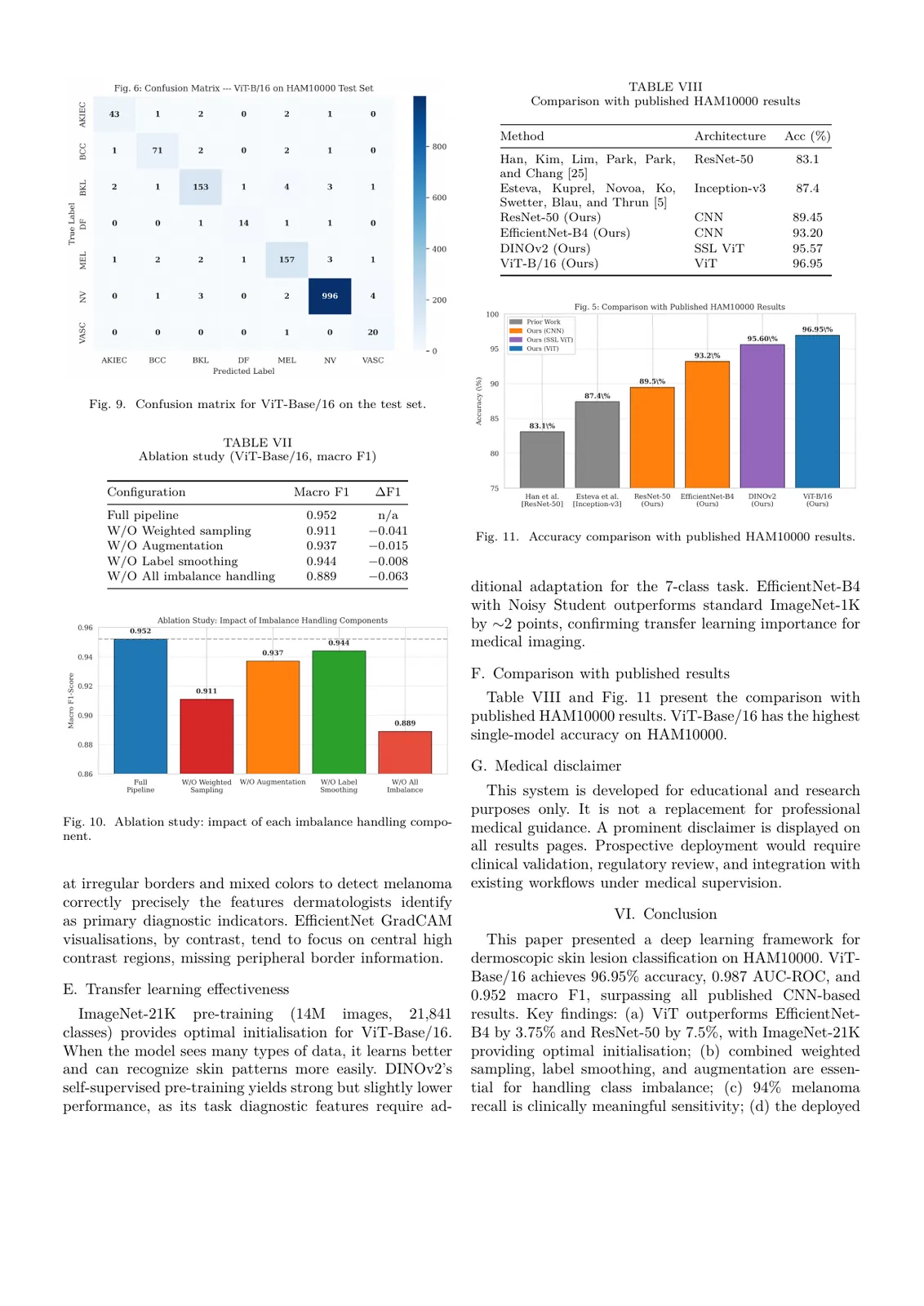
Here is the pattern as it ran in one delivered M.Tech project, skin lesion classification using a Vision Transformer. It shows how the published work, the baselines and the student’s own change fit together. The steps are from the real project; the wording is ours.
| Step | What the M.Tech project did |
|---|---|
| Problem and data | Seven-class classification of dermoscopic images on HAM10000, a public dataset in which benign moles make up most of the images |
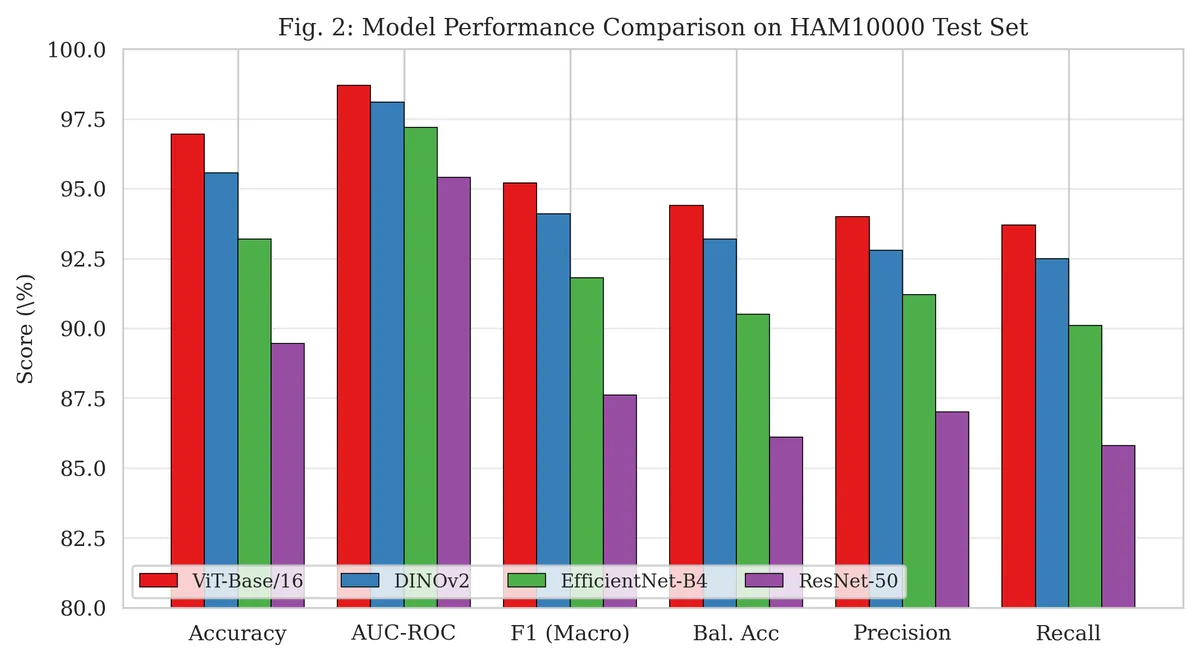
| Baselines | EfficientNet-B4 and ResNet-50, trained and tested under the same conditions as the new models |
| The change | Transformer models (ViT-Base/16 and DINOv2), plus class-imbalance handling: weighted sampling, label smoothing and extra augmentation for rare classes |
| Fair comparison | One split and six metrics for all four models; ViT-Base/16 scored highest on every metric |
| Ablation | Each imbalance fix removed in turn; dropping weighted sampling hurt macro F1 the most |
| Write-up | An IEEE-format paper that sets the results beside published HAM10000 results |
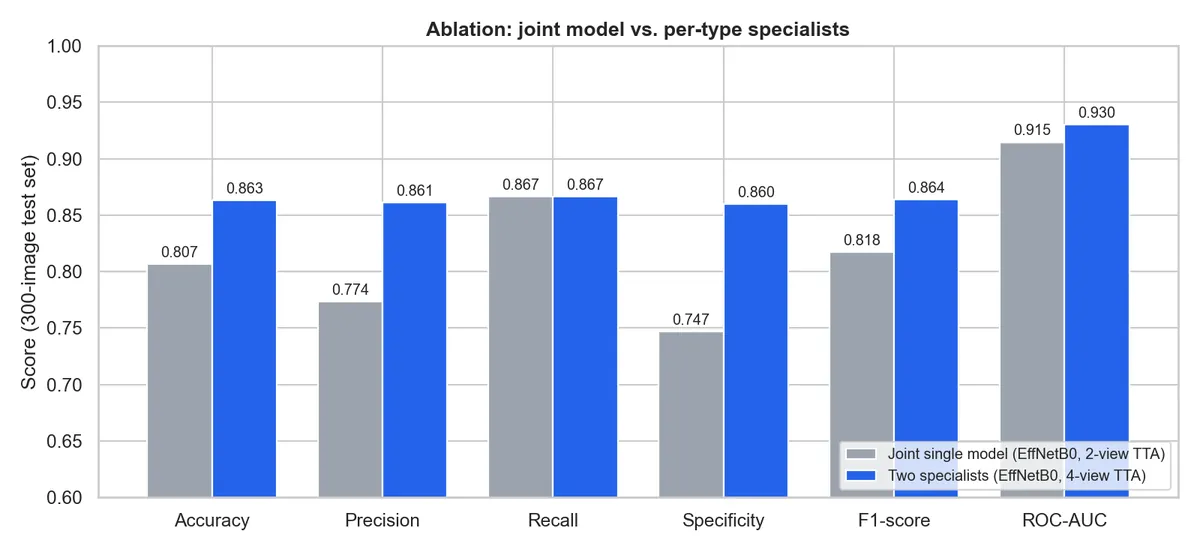
A second M.Tech project, Parkinson’s disease detection from spiral drawings, used an ablation the same way: two drawing-specific models beat one joint model on accuracy, precision, specificity, F1 and ROC-AUC. In your own project, the base paper’s reported numbers and your reproduction of them sit in the same table as your change.
How is a base paper for IEEE projects used?
In Indian engineering colleges, an “IEEE project” usually means a project built on a base paper from an IEEE journal or conference, often written up in IEEE format. The base paper fixes the problem, the dataset and the numbers to beat; your report or paper then shows the reproduction and your extension.
Two cautions. IEEE format is a layout, not a mark of quality: a paper is an IEEE publication only if it is on IEEE Xplore. And the name does not mean IEEE has approved the project. Our page on IEEE base paper implementation explains how it runs in practice, and final year projects for CSE covers B.Tech-level scope.
Frequently asked questions
What is a base paper in a project?
It is the published paper your project reproduces and then extends. Its method gives you a baseline, its limitations give you a problem to solve, and it is cited as the starting point of your work.
How old can a base paper be?
A paper from the last two or three years is a safe default, and your guide may set a stricter rule. Older, well-known papers still work as extra baselines in your comparison table.
Can I use an arXiv paper as a base paper?
You can, with care. arXiv papers are moderated but not peer reviewed, so look for a published version first and ask your guide whether a preprint is acceptable.
Where can I get IEEE base papers for free?
Abstracts on IEEE Xplore are free. For the full text, use your college library, open-access articles, or ONOS if your institution is government-run; Google Scholar’s “All versions” link can lead to the authors’ own copy.
How many base papers do I need?
One main base paper for the method you extend, plus several recent papers for the literature survey and the comparison table. Your guide decides the exact number.
Can I use the base paper’s code?
Usually yes, if its licence allows it and you credit it. State clearly what you reused and what you built, cite the paper, and follow your university’s academic rules.