Below is what goes in each section of a research paper, the order to write it in, a worked abstract, how to choose a conference or journal, how to format it in IEEE style, and the reasons papers are rejected.
- Use the IMRaD structure: introduction, method, results and discussion, between a title and abstract at the top and a conclusion and references at the end.
- Start from the results. A paper reports what you found; if the results are not ready, the paper is not either.
- Write the abstract last, as a short version of the finished paper: problem, method, result, meaning.
- Choose the venue before you format, and check that it is genuinely indexed. Its template and page limit shape the paper.
- Cite every source and disclose AI use where the venue asks. Many venues check submissions for text overlap.
What is the structure of a research paper?
Most engineering papers follow the same research paper structure, known as IMRaD (Introduction, Methods, Results and Discussion). The table shows what goes in each section and what a reviewer looks for there. Exact headings vary by venue, so match the author guidelines of the one you choose.
| Section | What to write | Reviewers look for |
|---|---|---|
| Title | The method and the problem in one specific line, without symbols or abbreviations | That it says what the paper does |
| Abstract and keywords | One paragraph: problem, method, main result, why it matters; then 4 to 6 keywords | A concrete result, not a promise |
| Introduction | The problem, why it matters, what is missing, and a short list of your contributions | Clear contributions they can check later |
| Related work | Recent work grouped by approach, with what each lacks; see our literature review guide | The gap your paper fills, and fair credit to others |
| Method | The proposed approach, with an architecture figure, equations and enough detail to reproduce it | That someone else could repeat it |
| Experiments and results | Dataset, setup, metrics, baselines, then results in tables and figures | A fair comparison on the same data |
| Discussion | What the results mean, where the method fails, and its limits | Honest limits, not only wins |
| Conclusion | What you showed, in a few sentences, and the next step | No new claims |
| References | Every source cited in the text, in the venue’s style | Recent, relevant and complete entries |
Many conference papers merge the discussion into the results section. Some venues also ask for an acknowledgment, a data availability statement or a declaration of competing interests; their author guidelines list what is required.
How do you write a research paper step by step?
Write in the order that makes each section easiest, not the order it is read in. Every step below builds on the one before it.
Fix the results
Finish the experiments first. Make the main table and the key figures, and write two or three sentences on what they show. If you are still deciding what to build on, see how to select a base paper.
Write the method
Describe exactly what produced those results: the data, the preprocessing, the model or design, the settings and the hardware. Draw the architecture figure here.
Write the experiments and discussion
Explain the setup, the metrics and the baselines, then walk through each table and figure and say what it means and where the method falls short.
Write the related work and introduction
Now that you know your contribution, describe the work it builds on and the gap it fills, and end the introduction with your list of contributions.
Write the conclusion, then the abstract and title
Summarise what you showed. Then write the abstract as a short version of the whole paper and make the title match it.
Format, check and submit
Move the text into the venue’s template, complete the references, read the PDF once more against the call for papers, and submit before the deadline.
How do you write the abstract of a research paper?
An abstract answers four questions in one paragraph: what problem, what you did, what you found, and why it matters. IEEE journals ask for 150 to 250 words; conferences set their own limit. Leave out equations, citations and abbreviations you have not defined, because the abstract is often read on its own.
Problem: “Plant leaf diseases reduce crop yield, and existing deep learning classifiers are often too large to run on the low-cost phones farmers use.” Method: “This paper proposes a lightweight convolutional network that combines depthwise separable convolutions with an attention module, trained on a public leaf image dataset.” Result: “On the held-out test set it reaches an accuracy of [xx.x]% with [n] million parameters, compared with [yy.y]% for the baseline.” Meaning: “The model runs on a mid-range phone without an internet connection, which makes field diagnosis practical.”
The bracketed values are placeholders, not results. Put in your own measured numbers, and name the dataset and baseline you actually used.
Then add 4 to 6 keywords (Index Terms in IEEE papers) that a reader would search for, such as “plant disease detection” and “lightweight CNN”.
Should you submit to a conference or a journal?
| Point | Conference | Journal |
|---|---|---|
| Length | A fixed page limit set in the call for papers | Usually longer, with a fuller study |
| Timeline | A fixed submission deadline and decision date | Submit any time; review and revision rounds take longer |
| Presentation | You usually present the paper, in person or online | No presentation |
| Suits | A first paper from a B.Tech or M.Tech project | A mature result, or a PhD requirement your university sets |
Whichever you choose, check three things before you submit:
- Is it really indexed? Look the journal up yourself in Scopus’s own source list, not on the journal’s website. Our guide on how to check if a journal is Scopus indexed shows how, including how to spot hijacked journals.
- Is it genuine? Be wary of emails inviting you to publish, acceptance within days, fees that appear only after acceptance, and a scope that covers every subject. The Think. Check. Submit. checklist helps you judge a journal.
- Does your university count it? The UGC CARE list has been discontinued, and your university now decides which journals count; see our UGC CARE list guide.
How do you format a research paper in IEEE format?
Most engineering conferences, and every IEEE one, use IEEE’s two-column layout: 10 pt Times body text, a 24 pt title, Roman-numeral section headings, “TABLE I” captions above tables and “Fig. 1.” captions below figures, and numbered references in square brackets. Our IEEE paper format guide covers every rule, with reference examples.
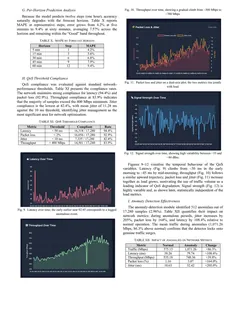
A free sample paper laid out in IEEE conference format can be downloaded from the top of this page, as Word and PDF. It is our own sample, not IEEE’s file: each section explains what to write there, with an example equation, table, figure placeholder and IEEE-style references. Use it to see how the parts fit together, then write your paper in the official template from IEEE’s conference templates page or the one your conference links.
Have results but no time to write the paper?
Send your results, your draft if you have one, and the target conference or journal. We help you write and format the paper in IEEE, Springer or journal format and shortlist suitable venues, after a free consultation and a fixed quote.
Why do research papers get rejected?
- Out of scope. The paper does not fit the topics in the call for papers or the journal’s aims and scope.
- No clear contribution. The introduction does not say what is new, or the novelty is only a change of dataset.
- Weak comparison. No baseline, a baseline run on different data, or results without the conditions they were measured in.
- Not reproducible. The method leaves out the data split, the settings or the preprocessing.
- Thin related work. Few recent papers, or recent work that does the same thing is missing.
- Format ignored. Over the page limit, the template’s margins changed or guidance text left in; see why papers get returned.
- Overlap with published text. Copied sentences, even from your own earlier work, without citation.
What are the rules on plagiarism and AI tools?
Write in your own words and cite every source you use, including figures and your own earlier papers. Many venues and universities check submissions for overlap with published text, so a paraphrase that follows the original too closely can still be flagged.
For AI tools, follow the policy of the venue you submit to. IEEE’s author guidelines for AI-generated text say that AI-generated content in an article, including text, figures, images and code, must be disclosed in the acknowledgments, naming the AI system and the sections where it was used. Using AI only for editing and grammar is treated as common practice, though disclosure is still recommended. Whatever tools you use, you are responsible for every claim and every reference, so check each one yourself.
Writing a paper from a project? IEEE projects and M.Tech projects cover the build, the results and the paper together, research paper writing and publication support covers the paper on its own, and PhD guidance covers papers as part of a doctorate.
Frequently asked questions
What is the format of a research paper?
Most engineering papers use the IMRaD structure: title, abstract, keywords, introduction, related work, method, experiments and results, discussion, conclusion, acknowledgment and references. The layout, such as IEEE two-column, comes from the template of the conference or journal you submit to.
In what order should I write a research paper?
Start with the results, tables and figures, then write the method that produced them, then the related work and introduction, then the conclusion. Write the abstract and the final title last, when you know exactly what the paper shows.
How long should a research paper abstract be?
Follow the limit your venue sets. IEEE journals ask for 150 to 250 words in a single paragraph, and conferences set their own limit in the call for papers. Avoid equations, citations and abbreviations you have not defined.
Should I publish in a conference or a journal?
A conference is usually faster and suits a first paper from an M.Tech or B.Tech project. A journal review takes longer and expects a fuller study. Check which your university counts for your degree, and confirm the venue is genuinely indexed before you submit.
Can I use ChatGPT or other AI tools to write my paper?
Check your venue’s policy. IEEE requires you to disclose AI-generated text, figures, images or code in the acknowledgments, naming the tool and the sections. Using AI only for editing and grammar is treated as common practice, though disclosure is still recommended. You remain responsible for every word.
Can The Ultimate Project World help me write a research paper?
Yes. Send your results, your draft if you have one, and the target conference or journal in the free consultation. We help you write and format the paper in IEEE, Springer or journal format and shortlist suitable venues. You must be able to explain every result in it.