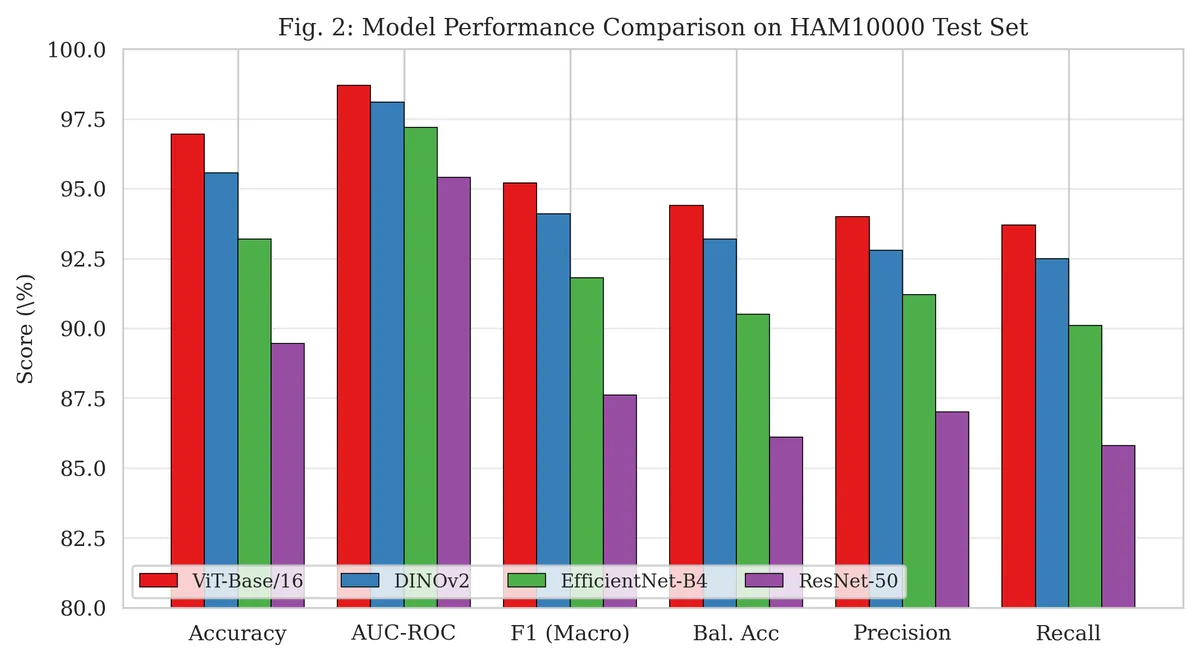
References are numbered in square brackets in the order you first cite them, with initials before surnames. Start from the official Word or LaTeX template, then follow your conference’s call for papers for the page limit, paper size and review rules.
Word (.docx, US Letter or A4) and LaTeX, for conferences: IEEE conference templates
LaTeX in the browser: IEEE Conference Template on Overleaf
IEEE journals and magazines: IEEE Template Selector
What is the IEEE paper format?
It is the page design IEEE uses for its conference proceedings and journals, delivered as ready-made templates. You do not build the layout yourself: you paste your content into the template and use its styles. The table below lists what the conference template produces, so you can check a draft against it.
| Element | IEEE format |
|---|---|
| Paper size | US Letter (8.5 × 11 in) or A4 (210 × 297 mm). IEEE offers Word templates in both; use the size your conference asks for. |
| Layout | Two columns. The title and author block run across the full width. |
| Columns and margins | Columns about 88 mm (3.5 in) wide with a gap of about 4.2 mm. Top margin 19 mm (0.75 in), with a deeper bottom margin. The template fixes these: do not change them. |
| Body text | Times (Times New Roman in Word), 10 pt, justified. |
| Title | 24 pt, centred. No symbols, special characters, footnotes or maths, and no subtitle. |
| Authors | Names in 11 pt; below each, department, organisation, city, country and email or ORCID. |
| Abstract | 9 pt bold, starting “Abstract—”. One paragraph with no equations, citations or footnotes. |
| Index Terms | 9 pt bold, starting “Index Terms—”, followed by your keywords. |
| Headings | I. INTRODUCTION (Roman numeral, centred small capitals) › A. Dataset (italic, flush left) › 1) Preprocessing: (italic, run into the paragraph) |
| Figures | Caption in 8 pt below the figure: “Fig. 1. Caption.” |
| Tables | Caption in 8 pt above the table: “TABLE I” with the title in small capitals under it. |
| Equations | Numbered consecutively, (1), (2), flush with the right margin. |
| References | 8 pt, numbered [1], [2] in order of first citation. “References” and “Acknowledgment” headings are not numbered. |
| Page numbers | None. Conference mode leaves headers and footers empty. |
Sizes and spacing are those of IEEE’s IEEEtran LaTeX class in conference mode at 10 pt, with heading and caption rules from the IEEE Editorial Style Manual. Your conference’s call for papers overrides anything here.
Where do you download the IEEE paper format template in Word or LaTeX?
Download it fresh for every paper. A file passed down from a senior may be years out of date, and conferences sometimes publish their own adjusted version.
- Conference papers: IEEE’s conference templates page has the Word template in US Letter and A4, and the LaTeX template.
- LaTeX online: the IEEE paper template on Overleaf needs no installation and suits co-authors editing together.
- Journals and magazines: the IEEE Template Selector gives the right template for each IEEE periodical.
- The class file itself: IEEEtran on CTAN, with the “How to use IEEEtran” guide.
Word or LaTeX? Word is fine for a short paper with few equations. LaTeX handles equations, cross-references and long reference lists better, and BibTeX formats references for you. Either way, keep the template’s styles and class options as they are.
How do you format a paper in IEEE style, step by step?
Read the call for papers
Note the page limit, paper size, template link, whether review is double-blind, and any word limit on the abstract.
Write the content first
IEEE’s template advises finishing and editing your text as a separate file before you format it.
Move it into the template
Paste section by section and apply the template’s styles. In LaTeX, let IEEEtran number the headings.
Place figures and tables
Put each one after its first mention, at the top or bottom of a column. Wide ones may span both columns.
Finish and check the PDF
Complete the references, delete every line of template guidance text, and run the PDF through IEEE PDF eXpress if your conference uses it.
Research paper format: the sections of an IEEE paper
IEEE’s style manual gives this order for articles. The body headings in between are yours to choose, but most engineering papers follow a pattern like the one shown. Many journals outside IEEE ask for a similar research paper format; what changes is the heading style and the reference format, so always check the author guidelines of the journal you choose.
- Title, authors and affiliations.
- Abstract: a single paragraph. IEEE journals ask for 150 to 250 words; conferences set their own limit.
- Index Terms: your keywords, which IEEE journals list alphabetically.
- I. Introduction: the problem, the gap and your contributions.
- Body sections: typically related work, the proposed method, the experimental setup, and results and discussion.
- Conclusion.
- Appendix (if any) and Acknowledgment (unnumbered; spelled without an “e” after the “g”).
- References (unnumbered heading).
If you used AI tools to generate text, figures or code, IEEE’s style manual requires you to disclose it in the Acknowledgment, naming the tool and the sections involved. Using AI only for editing and grammar is treated as common practice, though disclosure is still recommended.
How are headings, figures, tables and equations formatted?
Headings
Primary headings use Roman numerals and centred small capitals (I. INTRODUCTION). Secondary headings use capital letters and italics (A. Dataset). Third-level headings are italic, numbered 1), 2), and run into the paragraph after a colon. Only add sub-headings if there are at least two at that level.
Figures
The caption goes below the figure and starts “Fig. 1.”, and you write “Fig. 1” in the text even at the start of a sentence. Label axes with words and put units in brackets: “Temperature (K)”, not “Temperature/K” or just “K”. Keep figure labels legible at 8 pt.
Tables
The caption goes above the table: “TABLE I” in Roman numerals, then the title on the next line with no full stop at the end. Table footnotes use letters.
Equations
Number equations consecutively and refer to them as “(1)”, not “Eq. (1)”, except at the start of a sentence (“Equation (1) is…”). Italicise Roman-letter variables but not Greek letters, punctuate equations as part of the sentence, and define every symbol before or right after the equation.
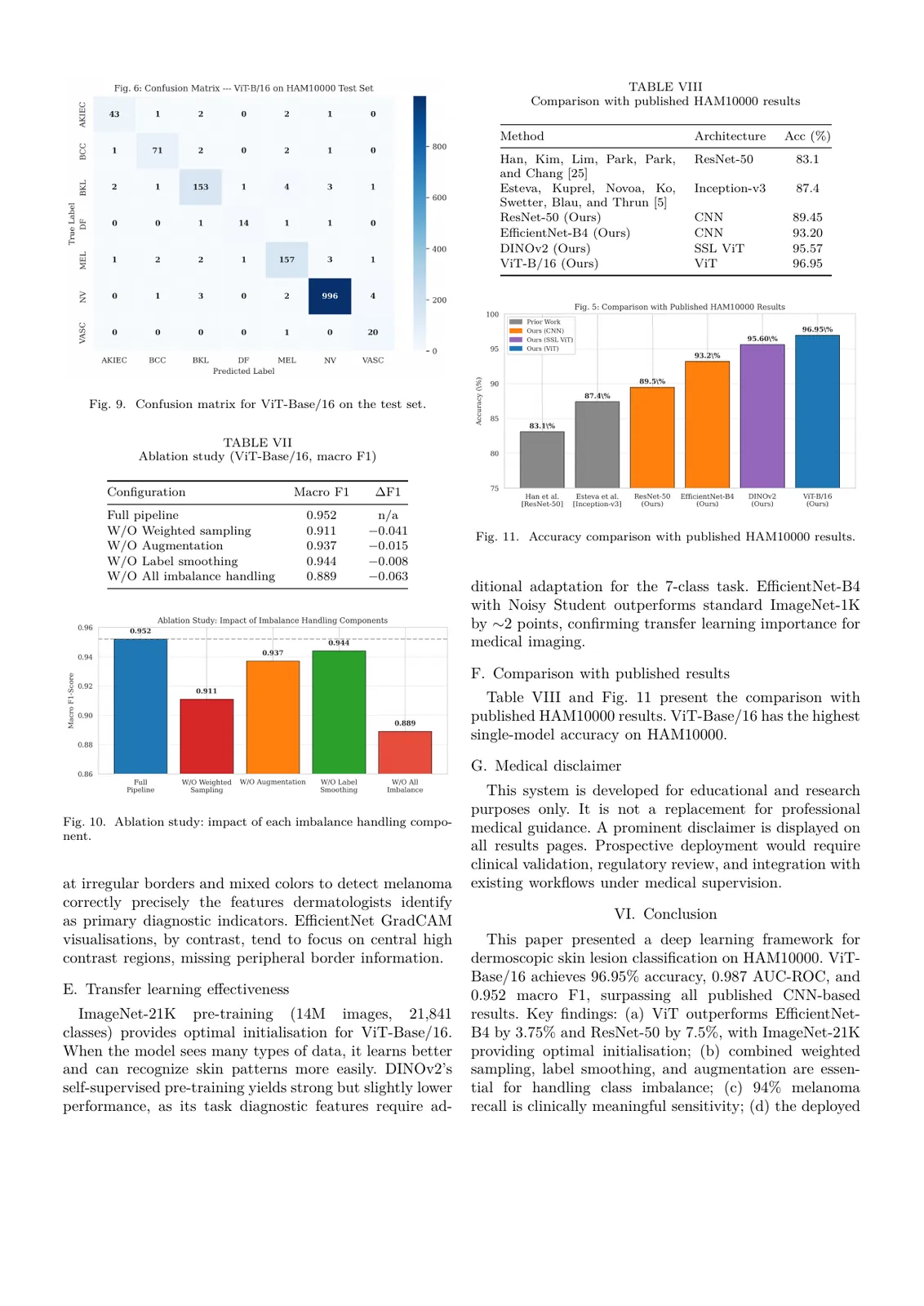
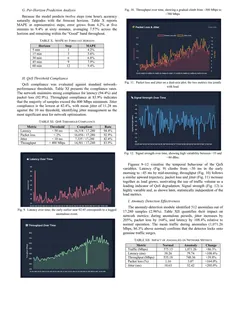
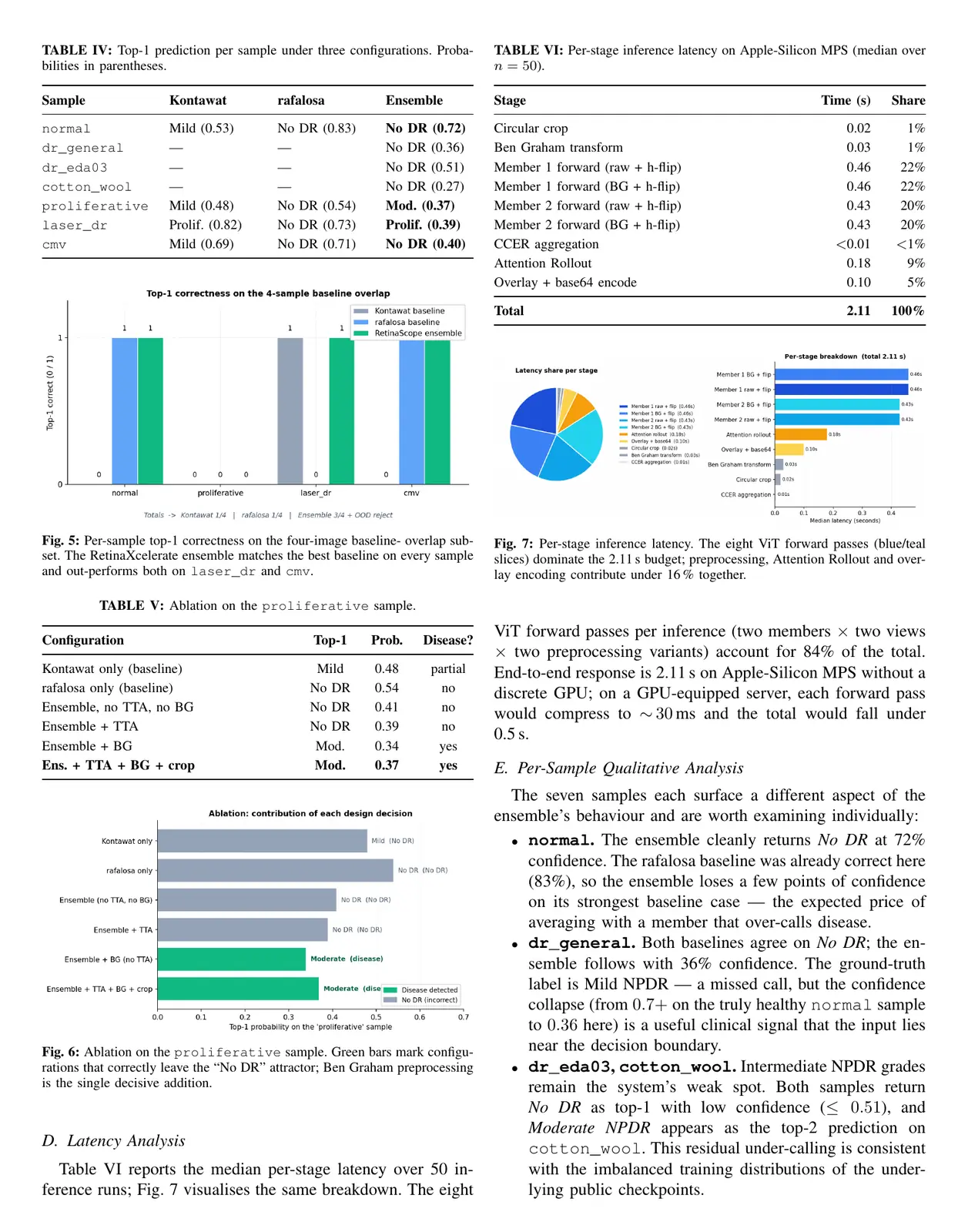
Shown with student, guide and institute details removed.
IEEE paper format example: what to notice on that page
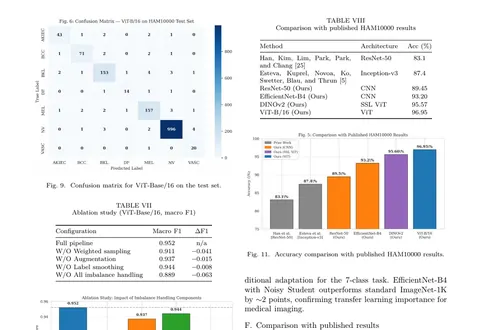
The page above comes from the M.Tech project on skin lesion classification using a Vision Transformer. Open it at full size and check these points against your own draft:
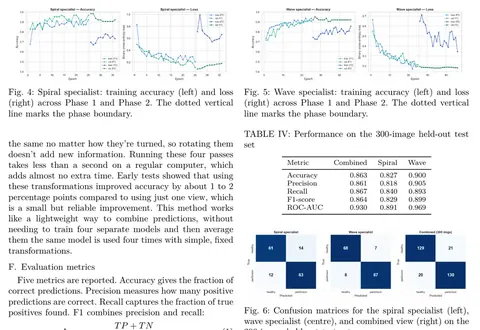
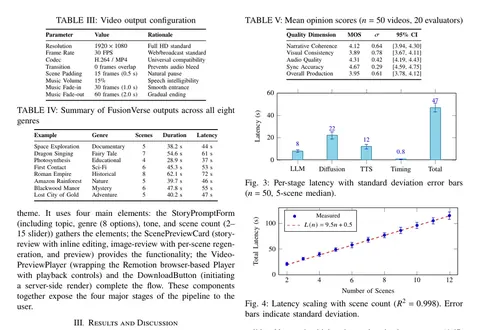
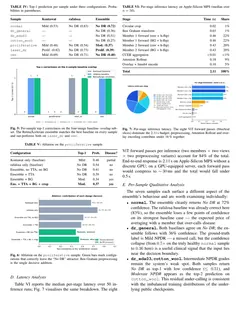
- Two columns throughout, with each table and figure placed at the top or bottom of a column.
- Table captions above the table: “TABLE VII” in Roman numerals, with the title on the line below.
- Figure captions below the figure: “Fig. 9. Confusion matrix for ViT-Base/16 on the test set.”
- Heading levels: lettered subsections (E., F., G.) inside a Roman-numeral section, and “VI. Conclusion” opening the next one.
- Numbered citations in square brackets, such as [5] and [25] in the comparison table.
How do you write references in IEEE format?
The IEEE format for references uses numbered citations. The rules below come from the IEEE Reference Guide (2025 edition) and the conference template.
- Number sources in the order you first cite them, in square brackets inside the sentence punctuation: “as shown in [3].”
- Refer to the number itself: “in [3]”, not “in Ref. [3]”, except at the start of a sentence.
- The current guide writes ranges out in full: [1], [2], [3], [4] rather than [1]–[4].
- Give initials before the surname. List up to six authors; with more than six, give the first author followed by “et al.”
- Put article titles in quotation marks, capitalising only the first word and proper nouns. Italicise journal and book titles and abbreviate journal names (IEEE Trans. Biomed. Eng.).
- Add the DOI when there is one. Each number holds exactly one source.
| Source | Example in IEEE style |
|---|---|
| Journal article | [1] Y. LeCun, L. Bottou, Y. Bengio, and P. Haffner, “Gradient-based learning applied to document recognition,” Proc. IEEE, vol. 86, no. 11, pp. 2278–2324, Nov. 1998, doi: 10.1109/5.726791. |
| Conference paper | [2] K. He, X. Zhang, S. Ren, and J. Sun, “Deep residual learning for image recognition,” in Proc. IEEE Conf. Comput. Vis. Pattern Recognit. (CVPR), Las Vegas, NV, USA, 2016, pp. 770–778, doi: 10.1109/CVPR.2016.90. |
| Book | [3] I. Goodfellow, Y. Bengio, and A. Courville, Deep Learning. Cambridge, MA, USA: MIT Press, 2016. |
| Preprint (arXiv) | [4] A. Vaswani et al., “Attention is all you need,” 2017, arXiv:1706.03762. |
| Dataset | [5] P. Tschandl, 2018, “The HAM10000 dataset, a large collection of multi-source dermatoscopic images of common pigmented skin lesions,” Harvard Dataverse, doi: 10.7910/DVN/DBW86T. |
| Thesis | [6] J. K. Author, “Title of thesis,” Ph.D. dissertation, Dept. Elect. Eng., Univ. Name, City, Country, 2025. |
| Web page | [7] IEEE. “IEEE Reference Guide.” IEEE Author Center. Accessed: Sep. 29, 2026. [Online]. Available: https://journals.ieeeauthorcenter.ieee.org/wp-content/uploads/sites/7/IEEE_Reference_Guide.pdf |
Row 6 is the guide’s pattern with placeholders. Cite a paper that is accepted but not yet out as “to be published”, and one still under review as “submitted for publication”.
Why do IEEE-format papers get returned before review?
A paper can be sent back without review for its format alone, however good the research. These problems are easy to catch before you submit.
| Problem | Fix |
|---|---|
| Over the page limit | Cut text or move detail to an appendix. The limit and any paid extra pages are set in the call for papers. |
| Margins, fonts or spacing changed to fit more | Restore the template. IEEE’s template states that margins, column widths, line spacing and fonts are prescribed. |
| Template guidance text left in | Delete every instruction line. The LaTeX template warns that leftover text may stop the paper being published. |
| Author names in a double-blind submission | Remove names, affiliations, acknowledgments and self-identifying links until the camera-ready version. |
| PDF fails IEEE’s checks | Embed all fonts, remove passwords, bookmarks and links, and validate with IEEE PDF eXpress when the conference requires it. |
| Mixed or incomplete references | Use one numbered style throughout, with every author, title, venue, year and page range filled in. |
| Maths or symbols in the title or abstract | Rewrite them in words; the template forbids symbols, maths and footnotes there. |
PDF requirements are listed on the IEEE Author Center page Meet IEEE Xplore requirements. Conferences may also screen submissions for text overlap with published work.
Need your paper written or formatted?
We write and format research papers in IEEE, Springer and journal formats for M.Tech and PhD students, from the results you already have. See research paper writing and publication support. If the paper comes out of a project, IEEE projects and M.Tech projects cover the build, the results and the paper together. Your final submission is usually a PDF, so run the checks in the next section on the PDF itself, not only on the Word or LaTeX source. Formatting a paper in IEEE style does not make it an IEEE publication: that happens only when an IEEE conference or journal accepts it. Still choosing a journal? See how to check if a journal is Scopus indexed.
Our work is writing support, formatting and explanation. Cite every source, disclose tool use where the venue asks, and make sure you can explain every result in the paper.
Frequently asked questions
What font and size does the IEEE paper format use?
Times (Times New Roman in Word) at 10 pt for the body text. The title is 24 pt, author names 11 pt, the abstract and Index Terms 9 pt bold, and figure captions, table captions and references 8 pt.
Where can I download the IEEE paper format template in Word?
From IEEE’s conference templates page, which has the Word template in US Letter and A4 sizes and the LaTeX template. For an IEEE journal or magazine, use the IEEE Template Selector, and always use the template your conference links in its call for papers if it gives one.
Is the IEEE paper format A4 or US Letter?
Both exist. IEEE offers Word templates in US Letter and A4, and the IEEEtran LaTeX class supports both. IEEE itself mainly uses US Letter, so follow the paper size your conference names in its call for papers.
How many pages is an IEEE conference paper?
Each conference sets its own limit in the call for papers, and some allow extra pages for a charge. Check whether references count towards the limit before you cut content.
How do you cite references in IEEE format?
Number each source in the order you first cite it and put the number in square brackets, such as [1]. The reference list follows the same order, with initials before surnames, article titles in quotation marks and abbreviated, italic journal names.
Does using the IEEE template mean my paper is published by IEEE?
No. The template only sets the layout. A paper becomes an IEEE publication when an IEEE conference or journal accepts it after review and it appears in IEEE Xplore.
Do I have to disclose AI use in an IEEE paper?
Yes, if AI generated any text, figures, images or code. IEEE’s style manual asks you to name the tool and the sections in the Acknowledgment. Using AI only for editing and grammar is treated as common practice, though disclosure is still recommended.